Systemic risks force sustainability into core of business decision-making





The growing connection between climate, water, energy, supply chain, social and geopolitical risks is forcing businesses to rethink sustainability as a core component of strategy, capital allocation and operational decision-making.
This was the consensus highlighted during a leadership panel discussion titled “Systemic risks and how they are shaping sustainability leadership and focus” on the first day of the Sustainability and ESG Africa Conference & Expo 2026, held in Johannesburg, on September 30.
The discussion was moderated by National Business Initiative CEO Shameela Soobramoney and the panellists included financial services company Nedbank sustainability executive head Bridgitte Burnett, multinational Internet, technology and multimedia holding company Naspers global sustainability business partner Ronell Govender, pharmaceutical retailer Dis-Chem CFO Julia Pope and multinational food and beverage company Nestlé Southern and East Africa CFO Namit Mishra.
The panel examined how companies are responding to systemic risks that increasingly cut across traditional environmental, social and governance (ESG) categories, as well as how these risks are influencing leadership, capital allocation, supply chains and broader business strategy.
Soobramoney noted that African businesses were increasingly managing sustainability in the context of interconnected systemic risks rather than isolated ESG issues.
“What this challenges us to do is to be able to think systemically and not from a tick-box approach,” she said.
She also identified climate and water stress, energy insecurity, economic volatility, supply chain disruptions, social pressures and nature-related dependencies as key among the risks businesses needed to consider, noting that these could reinforce one another and develop into strategic and financial risks.
However, Burnett said businesses needed to understand how different risks interacted across their value chains and how interventions could address several risks simultaneously.
“It really is around our mindset and how do we think around this at a systems level, understanding that each of us – businesses, individuals and the public sector – are part of the ecosystem. What we do impacts the ecosystem and what happens in that ecosystem impacts us,” she said.
She said this systems-level approach was also influencing how Nedbank considered sustainability in financing and credit decisions.
Meanwhile, Mishra highlighted that systemic risks were already manifesting across Nestlé's operations, using water scarcity as an example of how an environmental issue could cascade through agriculture, food availability and inflation before ultimately affecting business decisions.
He added that this interconnectedness meant sustainability could not be treated as the responsibility of a single department.
“Sustainability should not come as a surprise on our desk, it has to be an integral mainstream topic of discussion,” Mishra said.
Further, he argued that sustainability also needed to be integrated across the corporate C-suite level and wider business, while companies needed to work with business partners across their value chains to build resilience.
He pointed to Nestlé's work with farmers, regenerative agricultural practices and packaging circularity as examples of interventions aimed at strengthening the wider ecosystem in which the company operated.
Pope said sustainability considerations were increasingly becoming part of everyday capital-allocation and operational decisions at Dis-Chem.
The company is incorporating sustainability considerations into decisions around new stores, including water supply, solar power, refrigeration and supply chain choices.
She said sustainability-related investments could also deliver financial benefits, pointing to Dis-Chem's investment in solar power.
“The return that we made in solar we thought would come back in five years. It's coming back in three and, as a CFO, those are the decisions you've also got to interrelate,” Pope said.
Providing the Naspers perspective, Govender said accountability remained a significant challenge in managing systemic risks, particularly when risks crossed organisational boundaries.
“The governance gap is not a knowledge problem. It's an accountability architectural problem. We know that systemic risks exist but the struggle is about who owns the risk at the intersection and who is incentivised on acting on the risk,” she said.
She said companies needed clearer structures, mandates and board visibility to ensure accountability for systemic risks remained in place even as leadership teams and business priorities changed.
Govender also pointed to the importance of Naspers’ governance structures, including board-level oversight and dedicated committees, as part of its approach to embedding sustainability and systemic-risk considerations into decision-making.
The panel also highlighted collaboration between companies, policymakers, financiers, suppliers and other stakeholders as essential to addressing systemic risks.
Burnett said collaboration and trust had helped financial institutions understand the relevance of systemic considerations to financing decisions, while Pope highlighted the importance of bringing different parts of a business into capital-allocation and supply chain decisions.
Mishra pointed to collaboration with suppliers and other stakeholders as a way of strengthening business ecosystems.
Burnett concluded the discussion by highlighting leadership itself and the distinct cultural values associated with this as an important resource for Africa.
“I think that I would like to leave the room with a thought of a natural resource that we actually sit with as a country and, uniquely, as Africa, and that is our leadership and our solution and problem solving for the collective, and the spirit of Ubuntu. I think this is something that we can bring into this agenda,” she said.
Article Enquiry
Email Article
Save Article
Feedback
To advertise email advertising@creamermedia.co.za or click here

Projects

Latest News


Showroom
Established in 1933, EKATO is the world leader in agitation technology, supplying agitators for processes and applications such as chemicals and...
VISIT SHOWROOM
ESAB South Arica, the leading supplier of high-end welding and cutting products to the Southern African industrial market is based in...
VISIT SHOWROOM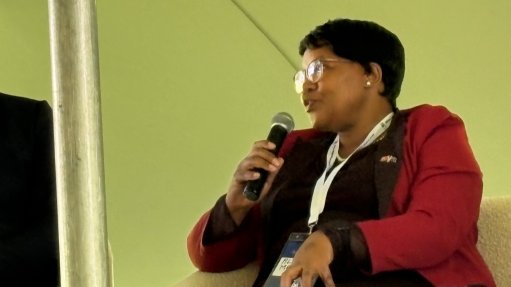



Announcements
What's On
Subscribe to improve your user experience...
Option 1 (equivalent of R125 a month):
Receive a weekly copy of Creamer Media's Engineering News & Mining Weekly magazine
(print copy for those in South Africa and e-magazine for those outside of South Africa)
Receive daily email newsletters
Access to full search results
Access archive of magazine back copies
Access to Projects in Progress
Access to ONE Research Report of your choice in PDF format
Option 2 (equivalent of R375 a month):
All benefits from Option 1
PLUS
Access to Creamer Media's Research Channel Africa for ALL Research Reports, in PDF format, on various industrial and mining sectors
including Electricity; Water; Energy Transition; Hydrogen; Roads, Rail and Ports; Coal; Gold; Platinum; Battery Metals; etc.
Already a subscriber?
Forgotten your password?
Receive weekly copy of Creamer Media's Engineering News & Mining Weekly magazine (print copy for those in South Africa and e-magazine for those outside of South Africa)
➕
Recieve daily email newsletters
➕
Access to full search results
➕
Access archive of magazine back copies
➕
Access to Projects in Progress
➕
Access to ONE Research Report of your choice in PDF format
RESEARCH CHANNEL AFRICA
R4500 (equivalent of R375 a month)
SUBSCRIBEAll benefits from Option 1
➕
Access to Creamer Media's Research Channel Africa for ALL Research Reports on various industrial and mining sectors, in PDF format, including on:
Electricity
➕
Water
➕
Energy Transition
➕
Hydrogen
➕
Roads, Rail and Ports
➕
Coal
➕
Gold
➕
Platinum
➕
Battery Metals
➕
etc.
Receive all benefits from Option 1 or Option 2 delivered to numerous people at your company
➕
Multiple User names and Passwords for simultaneous log-ins
➕
Intranet integration access to all in your organisation