UJ, SAMCT launch R2.5m mobile optometry clinic

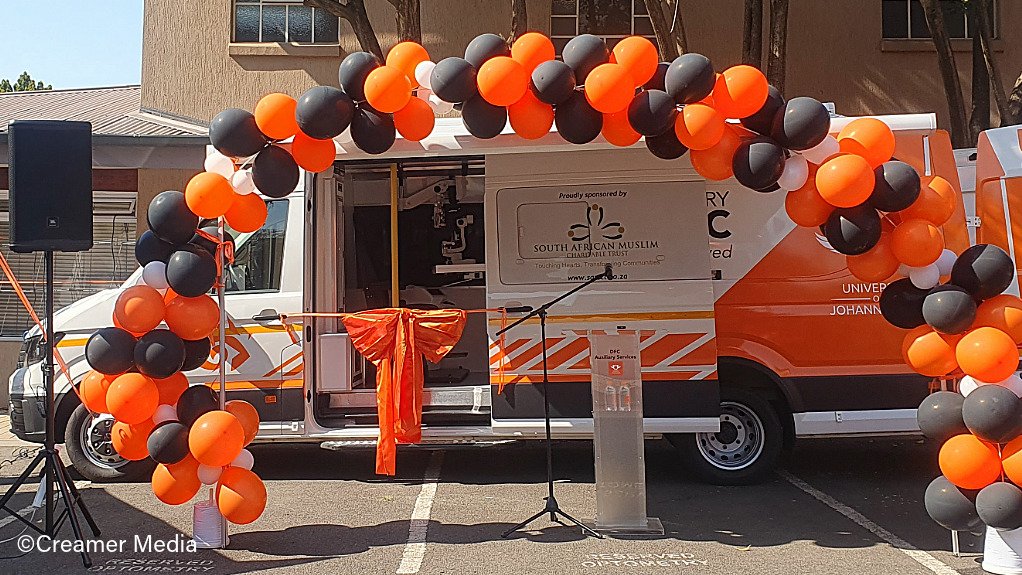
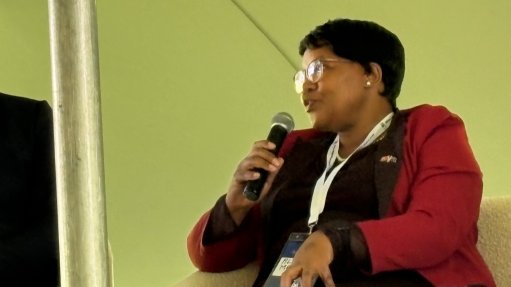
UJ vice chancellor and principal Professor Letlhokwa Mpedi, UJ Department of Optometry head Professor Nabeela Hasrod Gany and SAMCT trustee Gaff Osman discuss the significance of the partnership between UJ and the SAMCT in launching the mobile optometry unit
Photo by Creamer Media's Sabrina Jardim
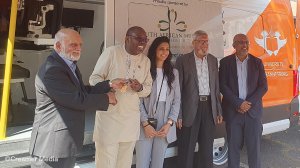
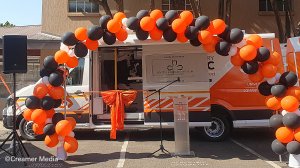


The University of Johannesburg (UJ), in partnership with nonprofit organisation the South African Muslim Charitable Trust (SAMCT), has launched a new R2.5-million, fully equipped mobile optometry clinic, designed to deliver comprehensive eye care directly to communities.
Unlike a conventional screening vehicle, the mobile clinic is equipped for comprehensive eye examinations and ocular health assessments. It incorporates a fully integrated spectacle-cutting laboratory, allowing for lenses to be edged and glazed on site.
This creates the potential for a patient to move from eye examination to prescription, to spectacle manufacture and dispensing within the same community outreach visit.
UJ explained during a September 28 demonstration that patients living far from established eye-care services, returning to collect spectacles may mean additional transport costs, time away from work or school and another journey that is not always possible.
“For many South Africans, the challenge is not simply whether appropriate eye care exists; the challenge is whether they can access it. If the clinic is far away, if transport is unaffordable or if a patient must make several journeys between examination, prescription and eventually receiving spectacles, even relatively straightforward eye care needs can remain unmet.
“The UJ–SAMCT Mobile Optometry Clinic changes the geography of that relationship. Instead of waiting for the patient to come to the university, the university can go to the patient,” said UJ vice chancellor and principal Professor Letlhokwa Mpedi during the launch.
Following its launch at UJ, the Mobile Optometry Clinic will undertake its first community deployment in Cosmo City on World Sight Day in October, taking the clinic's comprehensive eye-care and spectacle services directly into the community.
World Sight Day is observed yearly on the second Thursday of October and draws global attention to blindness, vision impairment and the importance of accessible eye care.
UJ said the Cosmo City outreach would provide a fitting first journey for a clinic built around a simple principle: where geography creates a barrier to eye care, healthcare must become mobile.
Beyond community service, the clinic will also serve as a mobile teaching platform for UJ Optometry students, exposing future practitioners to the realities of healthcare access while developing clinical competence, adaptability and socially responsive practice.
The initiative brings together teaching, community engagement and societal impact, while creating a sustainable platform through which UJ can extend its healthcare footprint beyond the university's physical campuses.
“Universities have a responsibility to educate graduates who are technically competent, but our responsibility cannot end there. We must also develop graduates who understand the societies in which they will practice,” said Mpedi.
ADDRESSING THE NEED
UJ explained that the model is particularly significant, noting that something as straightforward as uncorrected refractive error can affect education, employment, independence and quality of life.
In a media release, UJ noted that, according to the World Health Organisation (WHO), at least 2.2-billion people worldwide live with near or distance vision impairment and at least one-billion cases could have been prevented or remain unaddressed.
Uncorrected refractive error remains a leading cause of vision impairment in both children and adults. The WHO further estimates that two out of every three people in low-income countries who need spectacles lack access to them.
UJ explained that underserved populations bear a disproportionate burden. The WHO reports that 90% of people living with unaddressed vision impairment or blindness are in low- and middle-income countries, reinforcing the need for models of care that take services closer to where people live.
Additionally, the university explained that, according to the WHO, school-age children with vision impairment can experience lower educational achievement, while vision impairment in adults can affect employment and productivity.
Globally, vision impairment is associated with an estimated $411-billion in yearly productivity losses.
With this in mind, UJ’s Department of Optometry has an established community outreach programme. In 2025 alone, the department conducted 53 outreach initiatives, examined about 5 520 patients and provided 1 038 pairs of spectacles free of charge.
However, UJ said the traditional outreach presents an important challenge that, while clinicians can travel into a community, examine a patient and diagnose a refractive problem, the manufacture and subsequent delivery of spectacles often happens elsewhere.
Hence, the new UJ–SAMCT Mobile Optometry Clinic has been designed specifically to help close this gap.
“Diagnosis without access to the solution is not enough. The mobile clinic allows us to take eye care to the patient and, importantly, to close the loop. We can identify the problem and, where possible, provide the spectacles that solve it – right there in the community,” said UJ Department of Optometry head Professor Nabeela Hasrod Gany in a media release.
Article Enquiry
Email Article
Save Article
Feedback
To advertise email advertising@creamermedia.co.za or click here
Projects

Latest Multimedia

Latest News

Showroom
Roytec Global is an international company specializing in liquid / solid and mineral separation technologies for the Mining and Industrial sectors.
VISIT SHOWROOM
Axiom Hydraulics is a trusted leader in South Africa’s hydraulic industry, delivering world-class components, systems, and engineering expertise...
VISIT SHOWROOM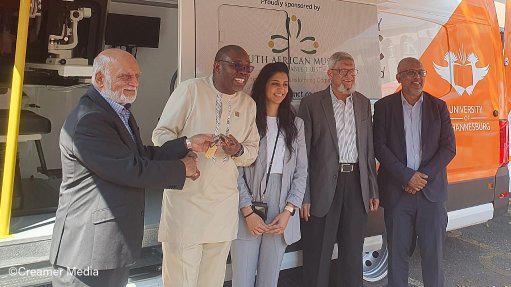


Press Office
Announcements
What's On
Subscribe to improve your user experience...
Option 1 (equivalent of R125 a month):
Receive a weekly copy of Creamer Media's Engineering News & Mining Weekly magazine
(print copy for those in South Africa and e-magazine for those outside of South Africa)
Receive daily email newsletters
Access to full search results
Access archive of magazine back copies
Access to Projects in Progress
Access to ONE Research Report of your choice in PDF format
Option 2 (equivalent of R375 a month):
All benefits from Option 1
PLUS
Access to Creamer Media's Research Channel Africa for ALL Research Reports, in PDF format, on various industrial and mining sectors
including Electricity; Water; Energy Transition; Hydrogen; Roads, Rail and Ports; Coal; Gold; Platinum; Battery Metals; etc.
Already a subscriber?
Forgotten your password?
Receive weekly copy of Creamer Media's Engineering News & Mining Weekly magazine (print copy for those in South Africa and e-magazine for those outside of South Africa)
➕
Recieve daily email newsletters
➕
Access to full search results
➕
Access archive of magazine back copies
➕
Access to Projects in Progress
➕
Access to ONE Research Report of your choice in PDF format
RESEARCH CHANNEL AFRICA
R4500 (equivalent of R375 a month)
SUBSCRIBEAll benefits from Option 1
➕
Access to Creamer Media's Research Channel Africa for ALL Research Reports on various industrial and mining sectors, in PDF format, including on:
Electricity
➕
Water
➕
Energy Transition
➕
Hydrogen
➕
Roads, Rail and Ports
➕
Coal
➕
Gold
➕
Platinum
➕
Battery Metals
➕
etc.
Receive all benefits from Option 1 or Option 2 delivered to numerous people at your company
➕
Multiple User names and Passwords for simultaneous log-ins
➕
Intranet integration access to all in your organisation