Compost yourself


Inattentional blindness, or change blindness, is considered a psychological glitch that occurs when the brain actively filters out unexpected details to avoid information overload, meaning you can completely miss things you are not directly focusing on.
The Strait of Hormuz conflict is arguably a case in point. Or is it rather attributable to a lack of employing another sense – becoming deaf to it?
While the news is occupied with the lack of marine traffic through the strait, it is not as preoccupied with its economic impact. They do not seem to give a . . . continental! There you might well have expected the expletive alternative to have been in play.
On that, although this piece is not technically about pure manure, it is about fertiliser, a synthetic or natural substance, created or mined to supply precise plant nutrients, such as nitrogen (N), phosphorus (P) or potassium.
On July 10, the World Trade Organisation, whose demise has been greatly exaggerated – with due acknowledgment to Mark Twain – published a blog post titled ‘Fertiliser trade impacted by Strait of Hormuz conflict’. It states that, according to its secretariat’s data analysis, trade in urea and phosphate fertilisers has been severely disrupted by the conflict in the Persian Gulf.
Let us pause on ‘urea and phosphate’ for a moment. Urea is an organic compound (CH4N2O) and the primary nitrogen-containing waste product found in mammalian urine. It is produced by the liver when it breaks down proteins, filtering out toxic ammonia. It is then transported to the kidneys for excretion from the body. Urea and phosphate (PO43-) are foundational agricultural inputs that supply the two most critical macronutrients for plant development: N and P. N promotes leafy green growth, while P drives root development, flowering, and fruiting. N and P are essential macronutrients vital for all life on Earth. In agriculture and ecosystems, they dictate plant health and growth rates.
As for fertiliser trade, certain economies in Africa and Asia are particularly vulnerable to any obstruction to maritime trade through the Hormuz Strait, a key channel for fertiliser trade, resulting in fertiliser shortages and price hikes. The resultant fertiliser disruption has raised concerns that farm yields could be compromised, with potential knock-on effects on food prices and global food security.
Outbound fertiliser-related shipments through the strait to destinations outside the Persian Gulf came to a standstill when the conflict started, and have remained close to zero since then. A stable resumption of shipments remains to be seen.
Gulf region economies account for 24.8% of global nitrogenous fertiliser exports and 11.4% of phosphatic fertiliser exports, while their presence in the potash trade is negligible. Asian economies account for 40% of nitrogenous fertiliser exports from the Gulf region, and about half of the region’s phosphatic exports (48%) were shipped there. Other major suppliers of nitrogenous and phosphatic fertilisers are China, Morocco, and Russia. Add to this the fact that global fertiliser exports are highly concentrated in a small number of suppliers.
The fertiliser imports of 18 economies are particularly exposed to disruptions in the Persian Gulf. India sources almost two-thirds of its nitrogenous fertiliser requirements from the region, while Thailand sources close to one-half. Other significant destinations include Australia, Brazil, Morocco, Nepal, Sri Lanka, and the US, as well as African economies such as Kenya, Malawi, Mozambique, Rwanda, South Africa, Tanzania, Uganda, and Zimbabwe.
It is particularly concerning that, as the Institute for Security Studies notes, South Africa imports roughly 80% of its crop production inputs and fertiliser.
If the closure of the Hormuz Strait is considered to de facto restrict all fertiliser exports from Gulf-region economies, then the share of affected trade accounts for 23.3%.
The International Food Policy Research Institute has established that restricting fertiliser exports could lead to increased global prices. Since fertilisers are critical for agricultural production, supply disruptions can impair crop yields, ultimately affecting the availability and accessibility of food. Higher energy prices have also increased demand for biofuels, raising feedstock prices. What’s more, the Gulf region’s economies are vulnerable to supply shocks owing to their reliance on imported food and feed products.
This conflict is the epitome of a collective international lose-lose on multiple levels.
Article Enquiry
Email Article
Save Article
Feedback
To advertise email advertising@creamermedia.co.za or click here
Projects
Latest Multimedia

Latest News

Showroom
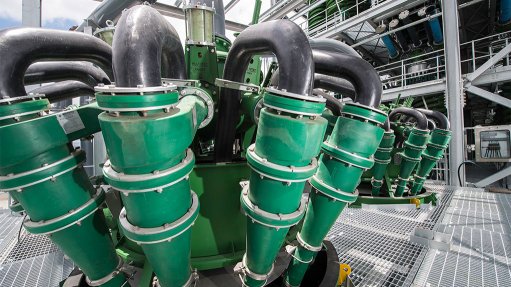
Multotec, recognised industry leaders in metallurgy and process engineering help mining houses across the world process minerals more efficiently,...
VISIT SHOWROOM
ZF Aftermarket is the after-sales division of the world-renowned German ZF group, a global leader in mobility technology.
VISIT SHOWROOM



Announcements
What's On
Subscribe to improve your user experience...
Option 1 (equivalent of R125 a month):
Receive a weekly copy of Creamer Media's Engineering News & Mining Weekly magazine
(print copy for those in South Africa and e-magazine for those outside of South Africa)
Receive daily email newsletters
Access to full search results
Access archive of magazine back copies
Access to Projects in Progress
Access to ONE Research Report of your choice in PDF format
Option 2 (equivalent of R375 a month):
All benefits from Option 1
PLUS
Access to Creamer Media's Research Channel Africa for ALL Research Reports, in PDF format, on various industrial and mining sectors
including Electricity; Water; Energy Transition; Hydrogen; Roads, Rail and Ports; Coal; Gold; Platinum; Battery Metals; etc.
Already a subscriber?
Forgotten your password?
Receive weekly copy of Creamer Media's Engineering News & Mining Weekly magazine (print copy for those in South Africa and e-magazine for those outside of South Africa)
➕
Recieve daily email newsletters
➕
Access to full search results
➕
Access archive of magazine back copies
➕
Access to Projects in Progress
➕
Access to ONE Research Report of your choice in PDF format
RESEARCH CHANNEL AFRICA
R4500 (equivalent of R375 a month)
SUBSCRIBEAll benefits from Option 1
➕
Access to Creamer Media's Research Channel Africa for ALL Research Reports on various industrial and mining sectors, in PDF format, including on:
Electricity
➕
Water
➕
Energy Transition
➕
Hydrogen
➕
Roads, Rail and Ports
➕
Coal
➕
Gold
➕
Platinum
➕
Battery Metals
➕
etc.
Receive all benefits from Option 1 or Option 2 delivered to numerous people at your company
➕
Multiple User names and Passwords for simultaneous log-ins
➕
Intranet integration access to all in your organisation