CSIR playing key role in international Southern Ocean carbon data project

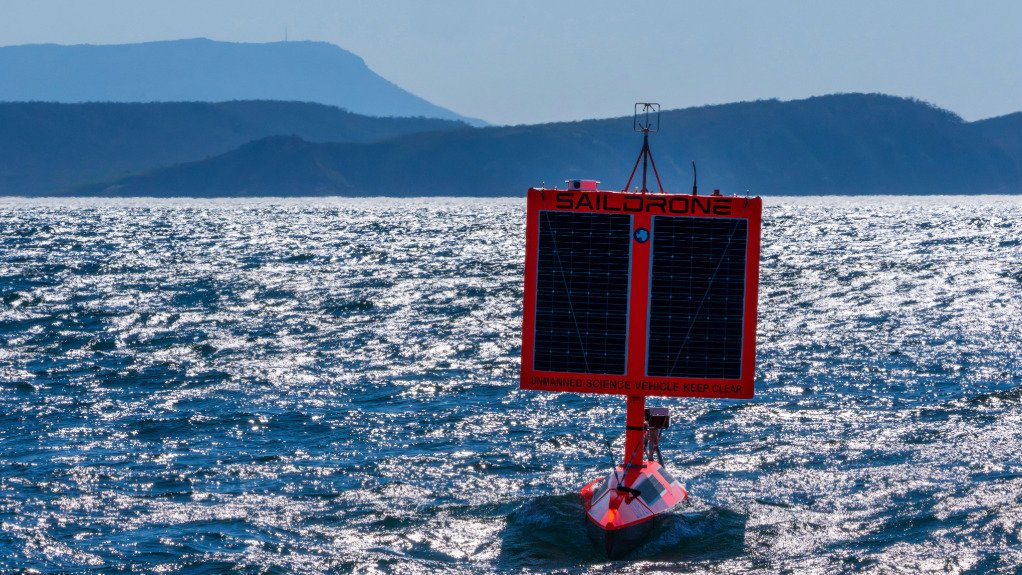


The Southern Ocean-focused Constraining Carbon with Optimised Observing (COCO2) research project, which unites researchers in South Africa, Australia and the US, is now under way and will soon be delivering data to the South Africa-based Southern Ocean Carbon Climate Observatory (SOCCO). The institutions involved in the project are the Council for Scientific and Industrial Research (CSIR), which hosts SOCCO, Australia’s Commonwealth Scientific and Industrial Research Organisation, the US National Oceanic and Atmospheric Administration, Columbia University (also in the US), and US uncrewed surface vessel (USV) manufacturer Saildrone. The project is funded by US philanthropic science funding agency Schmidt Sciences.
The Southern Ocean is the ocean that encircles Antarctica, and is under-observed, with data basically available for only the summer months, which is when ships sail down to Antarctica. Yet it is known to be responsible for 40% of the total global oceanic uptake of carbon dioxide, while also being responsible for absorbing 75% of the heat produced by the excess carbon dioxide that stays in the atmosphere. So, instead of ships, COCO2 will use Saildrone’s USVs.
“The Southern Ocean is thus a disproportionally important ocean when it comes to buffering the impacts of climate change,” highlighted CSIR chief researcher and SOCCO head Dr Sandy Thomalia. “South Africa is a big player in the global climate science space and the observations we will collect in the Southern Ocean using these USVs will help close the biggest observational gap in carbon dioxide data during winter.”
The USVs, as the name of their manufacturer (Saildrone) suggests, are wind-powered, while their onboard sensors are solar-powered. The USVs take the form of small sailing boats, and the first was released off Bruny Island, near Hobart, Tasmania, Australia, on September 20. The project will employ four of these USVs, which will be released at three-monthly intervals. Each will sail more than 22 000 km, circumnavigating Antarctica and eventually returning to Hobart, where they will receive maintenance and sensor upgrades.
“We will look at the role of winds, waves and ocean currents to see how they drive changes in carbon dioxide fluxes (fluxes refers to carbon dioxide entering or leaving the water) regionally and seasonally,” explained CSIR SOCCO project lead oceanographer Dr Sarah Nicholson. “The project will focus specifically on obtaining winter measurements, a critical blind-spot in existing observations; ships typically travel south only during summer, so because of lack of ship access, scientists have hardly any observations of the Southern Ocean in winter. There is therefore a seasonal bias we are trying to address.”
Article Enquiry
Email Article
Save Article
Feedback
To advertise email advertising@creamermedia.co.za or click here
Projects

Latest Multimedia
Latest News

Showroom
Established in 1933, EKATO is the world leader in agitation technology, supplying agitators for processes and applications such as chemicals and...
VISIT SHOWROOM
Stewarts & Lloyds is a leading steel, tube, and engineering product supplier in South Africa.
VISIT SHOWROOM

Announcements
What's On
Subscribe to improve your user experience...
Option 1 (equivalent of R125 a month):
Receive a weekly copy of Creamer Media's Engineering News & Mining Weekly magazine
(print copy for those in South Africa and e-magazine for those outside of South Africa)
Receive daily email newsletters
Access to full search results
Access archive of magazine back copies
Access to Projects in Progress
Access to ONE Research Report of your choice in PDF format
Option 2 (equivalent of R375 a month):
All benefits from Option 1
PLUS
Access to Creamer Media's Research Channel Africa for ALL Research Reports, in PDF format, on various industrial and mining sectors
including Electricity; Water; Energy Transition; Hydrogen; Roads, Rail and Ports; Coal; Gold; Platinum; Battery Metals; etc.
Already a subscriber?
Forgotten your password?
Receive weekly copy of Creamer Media's Engineering News & Mining Weekly magazine (print copy for those in South Africa and e-magazine for those outside of South Africa)
➕
Recieve daily email newsletters
➕
Access to full search results
➕
Access archive of magazine back copies
➕
Access to Projects in Progress
➕
Access to ONE Research Report of your choice in PDF format
RESEARCH CHANNEL AFRICA
R4500 (equivalent of R375 a month)
SUBSCRIBEAll benefits from Option 1
➕
Access to Creamer Media's Research Channel Africa for ALL Research Reports on various industrial and mining sectors, in PDF format, including on:
Electricity
➕
Water
➕
Energy Transition
➕
Hydrogen
➕
Roads, Rail and Ports
➕
Coal
➕
Gold
➕
Platinum
➕
Battery Metals
➕
etc.
Receive all benefits from Option 1 or Option 2 delivered to numerous people at your company
➕
Multiple User names and Passwords for simultaneous log-ins
➕
Intranet integration access to all in your organisation