Deputy Minister cites African and South African opportunities in the blue economy

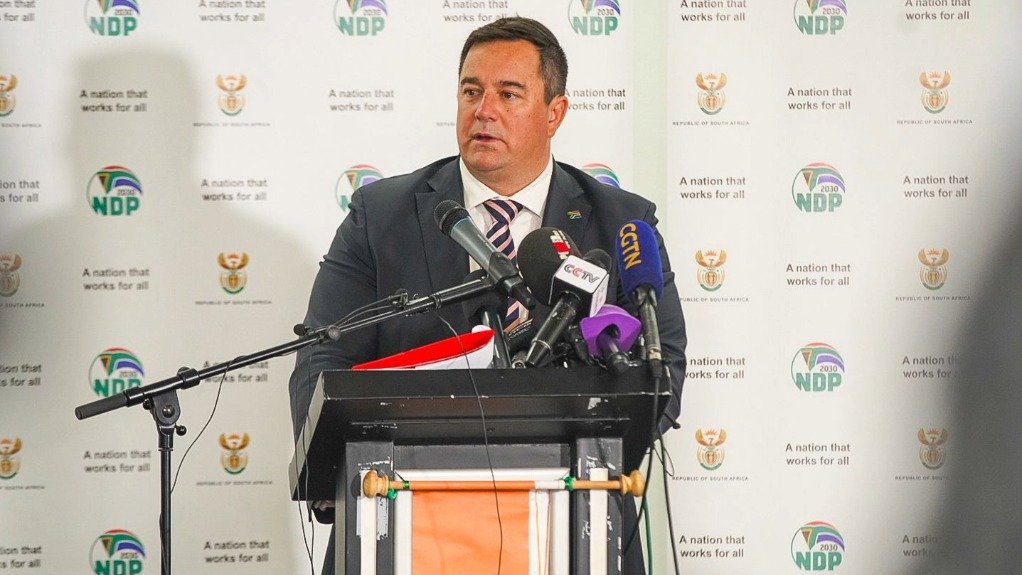


Africa’s blue economy – that is, the economic activities focused on or based in its oceanic, lacustrine and riverine environments – is no longer a future opportunity but a present reality providing opportunities for investors. So highlighted South African Trade, Industry and Competition Deputy Minister John Steenhuisen, in his address to the BlueInvest Africa South Africa 2026 Conference in Cape Town, on Monday.
“The question before all of us today is not whether opportunities exist,” he affirmed. “The question is how quickly we can develop bankable projects and mobilise the investment that is so important to unlock them.”
The blue economy contributed some €350-billion to the total continental economy, he observed. And there were still more opportunities, across a wide range of activities, including aquaculture, biotechnology, energy, fisheries, marine manufacturing, maritime transport, ocean science and ports and logistics.
“Governments, much as they like to think so sometimes, cannot achieve grand ambitions alone,” he stressed. “Private investment is fundamentally essential. Innovation is essential, and strategic partnerships are essential.” Those strategic partnerships also had to embrace non-governmental organisations and ocean-dependent communities, as well as businesses and governments. Further, there was a need to deepen regional and continental integration, to create interconnected value chains and supply chains, so spreading the benefits of the blue economy more widely.
This all had to be done in a way that ensured environmental sustainability and responsible natural resources management. The sector depended on healthy lakes, rivers, mangroves, estuaries and oceans for its long-term viability. And climate change was an added complication, which was bringing rising sea levels, coastal erosion, ocean warming and severe weather events, including droughts.
South Africa itself had a coastline of more than 3 000 km, along a major shipping route. With the Operation Phakisa Oceans Economy initiative and the draft Oceans Economy Roadmaps, the country, he assured, was seeking to open opportunities across a range of sectors. These included aquaculture and fisheries, coastal and marine tourism, marine manufacturing, marine protection, maritime transport, ocean governance, offshore oil and gas, renewable energy, ship repair, small harbour development, and renewable energy. He particularly highlighted the South African ship and boat building sector, and its partnerships with European companies.
“In 2025, South Africa exported over R5.7-billion worth of ships,” reported Steenhuisen. “It was up from R2.5-billion in 2016, and we see ourselves as a ship-building partner to the rest of the continent for both the civilian and defence sectors.”
South Africa, he cautioned, had to make climate change, sustainable investment and inclusive economic growth central to its oceanic and inland waters governance and development. At the same time, it had to ensure that small-scale fishers, vulnerable communities, entrepreneurs and emerging businesses also benefitted.
He pointed out that the conference also provided an opportunity to deepen cooperation between Africa and the EU. The relationship between the two was increasingly being shaped by investment, industrialisation, innovation, and sustainable development. A stronger partnership between Africa and the EU could assist with sustainable development and the creation of quality jobs, as well as with strengthening regional integration and growing continental trade.
“Africa is open for business,” he proclaimed. “Africa is open for investment, and Africa is open for partnership.”
Article Enquiry
Email Article
Save Article
Feedback
To advertise email advertising@creamermedia.co.za or click here
Projects
Latest Multimedia
Latest News
Showroom
SafeQuip is a leading distributor and manufacturer of fire safety solutions, offering a comprehensive range of products designed to meet all...
VISIT SHOWROOM
Design, Construction and Maintenance of Site Erected, Welded Bulk Storage Tanks for the Petrochemical, LNG, Ammonia and Sustainable fuel Sectors.
VISIT SHOWROOM


Press Office
Announcements
What's On
Subscribe to improve your user experience...
Option 1 (equivalent of R125 a month):
Receive a weekly copy of Creamer Media's Engineering News & Mining Weekly magazine
(print copy for those in South Africa and e-magazine for those outside of South Africa)
Receive daily email newsletters
Access to full search results
Access archive of magazine back copies
Access to Projects in Progress
Access to ONE Research Report of your choice in PDF format
Option 2 (equivalent of R375 a month):
All benefits from Option 1
PLUS
Access to Creamer Media's Research Channel Africa for ALL Research Reports, in PDF format, on various industrial and mining sectors
including Electricity; Water; Energy Transition; Hydrogen; Roads, Rail and Ports; Coal; Gold; Platinum; Battery Metals; etc.
Already a subscriber?
Forgotten your password?
Receive weekly copy of Creamer Media's Engineering News & Mining Weekly magazine (print copy for those in South Africa and e-magazine for those outside of South Africa)
➕
Recieve daily email newsletters
➕
Access to full search results
➕
Access archive of magazine back copies
➕
Access to Projects in Progress
➕
Access to ONE Research Report of your choice in PDF format
RESEARCH CHANNEL AFRICA
R4500 (equivalent of R375 a month)
SUBSCRIBEAll benefits from Option 1
➕
Access to Creamer Media's Research Channel Africa for ALL Research Reports on various industrial and mining sectors, in PDF format, including on:
Electricity
➕
Water
➕
Energy Transition
➕
Hydrogen
➕
Roads, Rail and Ports
➕
Coal
➕
Gold
➕
Platinum
➕
Battery Metals
➕
etc.
Receive all benefits from Option 1 or Option 2 delivered to numerous people at your company
➕
Multiple User names and Passwords for simultaneous log-ins
➕
Intranet integration access to all in your organisation