Solar considerations becoming more nuanced beyond kilowatt-hour savings

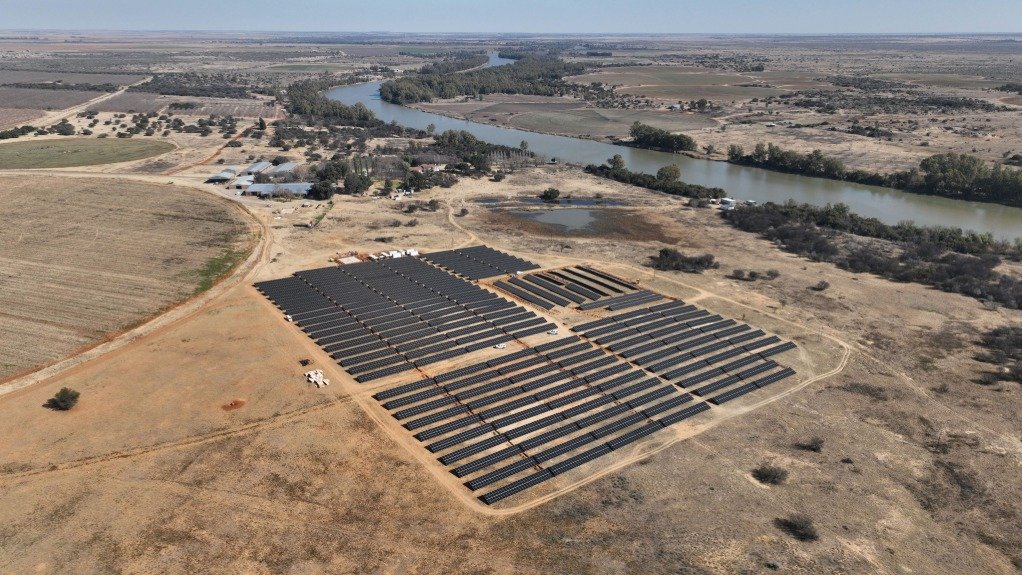


As Eskom’s fixed charges make up an increasing share of electricity bills, the economics of partial solar installations are becoming more nuanced, says renewable-energy engineering, procurement and construction company RenEnergy Africa business development head Juandré Pitout.
For South African farmers considering solar power, the question is no longer simply whether solar can reduce the amount of electricity bought from the grid but the added value of security of supply, clean energy and securing the levelised cost of energy (LCOE) for the farm over the next 20 years.
Pitout explains that grid constraints, such as those in the Western Cape, Eastern Cape and Northern Cape; registration requirements; connection costs; and the prospect of going fully off-grid are forcing agriculture businesses to look beyond the headline cost of ‘per kilowatt-hour’.
For example, if a farmer’s kilowatt-hour portion of their utility bill is 70% and 30% is fixed charges, then a grid-tied solar system that reduces electricity consumption by 30% does not deliver a 30% reduction in the overall bill. Rather, the saving applies primarily to the consumption component: 30% of 70%, or roughly 21% of the total bill.
This illustrates the challenge facing farmers, Pitout states, adding that installing solar can reduce grid-tied consumption substantially but leave a portion of the electricity bill untouched.
Eskom’s tariffs are not made up solely of charges for the energy consumed. Service and other fixed charges can remain payable even when a customer significantly reduces grid consumption.
This changes the calculation for a farmer or agribusiness considering a partial solar installation.
“The more the fixed component of the bill increases, the less impact a conventional grid-tied solar system has on the total bill. This does not necessarily undermine the business case for solar, but it does mean that farmers need to model the entire electricity bill rather than simply calculate how many kilowatt-hours a solar system will generate,” Pitout notes.
A farm with a large maximum-demand connection, for example, may need to consider whether its operations require that full capacity or whether there is scope to reduce its connection and associated charges.
Pitout is nonetheless confident that the economics of solar installations continue to improve and offer great value over the lifetime of assets. He mentions that solar equipment costs have decreased and combining solar with energy storage can increase the proportion of a farm’s electricity demand supplied by its own energy system.
Batteries can be used for backup power, load shifting or arbitrage, depending on a farm’s tariff structure and operating requirements.
Pitout says the objective should not necessarily be to maximise the size of the solar array, rather, the system needs to be designed around the farm’s actual electricity consumption and operational requirements. The commercial value of the installation is just as important as the technical application within the design. There is a delicate balance between over-design and commercials to make the most of the savings.
For some, the resulting system may be a relatively conventional grid-tied system and for others the economics may favour a hybrid or fully off-grid solution.
NO SIMPLE FEAT
Farmers need to factor in the cost and complexity of connecting solar to the grid, with Pitout stressing that there is no single fee that applies to every solar installation. The cost depends on the customer's existing connection and the work required by the utility.
Depending on the installation, this could include meter changes, transformer upgrades or other network requirements. The utility determines these costs during the connection or budget-quotation process rather than the solar installer simply setting the figure.
The type of meter can also matter. Where an existing meter cannot measure electricity flowing in both directions, it may need to be replaced with a suitable digital meter.
For farmers, this means the solar system's capital cost is only one part of the investment calculation. Registration, metering, connection work and potential network upgrades also need to be included.
The regulatory side of a solar installation is another consideration that farmers cannot afford to overlook.
Pitout urges customers to follow the applicable registration process with relevant municipalities or Eskom – for all solar installation sizes – and for those wanting to install larger projects to prepare for delays while grid capacity is assessed in the area.
Farmers should not assume that local networks have sufficient capacity to accommodate the proposed generation.
A solar installation connected behind the meter still interacts with the electricity network, and utilities therefore have to establish whether there is capacity, particularly for large-scale commercial operations. This can involve assessing the load on a substation and determining how much renewable-energy generation is already connected or proposed in the area.
A delayed solar project can impact operations, budgets, procurement schedules and expected savings.
OFF-GRID
Pitout says the economics of going fully off-grid are fundamentally different, requiring more solar panels, storage, generation profile data, peak demand considerations and backup plans during periods of low solar production.
The capital investment is consequently much larger than for convention grid-tied systems, while the design risk is also greater.
However, the potential financial benefits are also much greater. “A farm that successfully removes itself from the grid can eliminate not only the variable electricity charge but potentially fixed costs for themselves via their own LCOE for the next 20 years.
“These operations can also gain greater certainty about its future energy costs.”
Pitout mentions this “ring-fencing” of farm’s energy costs can offer valuable predictability, particularly for farmers operating on long production cycles.
Pitout summarises his sentiment by saying that the strongest motivation for an off-grid system may not be the electricity bill, but rather whether a farmer can afford power interruptions to irrigation, cooling, processing or other critical operations. The increasing cost of diesel and petrol amid conflict in the Middle East may also spur more farmers to considering solar installations.
Ultimately, reducing exposure to volatile energy costs can provide additional margin protection during all kinds of commodity price cycles, while wheeling arrangements can also become part of the equation to supplement on-site generation or sell excess capacity.
Article Enquiry
Email Article
Save Article
Feedback
To advertise email advertising@creamermedia.co.za or click here
Projects

Latest Multimedia
Latest News
Showroom
Established in 1933, EKATO is the world leader in agitation technology, supplying agitators for processes and applications such as chemicals and...
VISIT SHOWROOM
Stewarts & Lloyds is a leading steel, tube, and engineering product supplier in South Africa.
VISIT SHOWROOM

Announcements
What's On
Subscribe to improve your user experience...
Option 1 (equivalent of R125 a month):
Receive a weekly copy of Creamer Media's Engineering News & Mining Weekly magazine
(print copy for those in South Africa and e-magazine for those outside of South Africa)
Receive daily email newsletters
Access to full search results
Access archive of magazine back copies
Access to Projects in Progress
Access to ONE Research Report of your choice in PDF format
Option 2 (equivalent of R375 a month):
All benefits from Option 1
PLUS
Access to Creamer Media's Research Channel Africa for ALL Research Reports, in PDF format, on various industrial and mining sectors
including Electricity; Water; Energy Transition; Hydrogen; Roads, Rail and Ports; Coal; Gold; Platinum; Battery Metals; etc.
Already a subscriber?
Forgotten your password?
Receive weekly copy of Creamer Media's Engineering News & Mining Weekly magazine (print copy for those in South Africa and e-magazine for those outside of South Africa)
➕
Recieve daily email newsletters
➕
Access to full search results
➕
Access archive of magazine back copies
➕
Access to Projects in Progress
➕
Access to ONE Research Report of your choice in PDF format
RESEARCH CHANNEL AFRICA
R4500 (equivalent of R375 a month)
SUBSCRIBEAll benefits from Option 1
➕
Access to Creamer Media's Research Channel Africa for ALL Research Reports on various industrial and mining sectors, in PDF format, including on:
Electricity
➕
Water
➕
Energy Transition
➕
Hydrogen
➕
Roads, Rail and Ports
➕
Coal
➕
Gold
➕
Platinum
➕
Battery Metals
➕
etc.
Receive all benefits from Option 1 or Option 2 delivered to numerous people at your company
➕
Multiple User names and Passwords for simultaneous log-ins
➕
Intranet integration access to all in your organisation