South Africa’s Tshipi puts 828 000 t of manganese through Namibia’s Port of Lüderitz

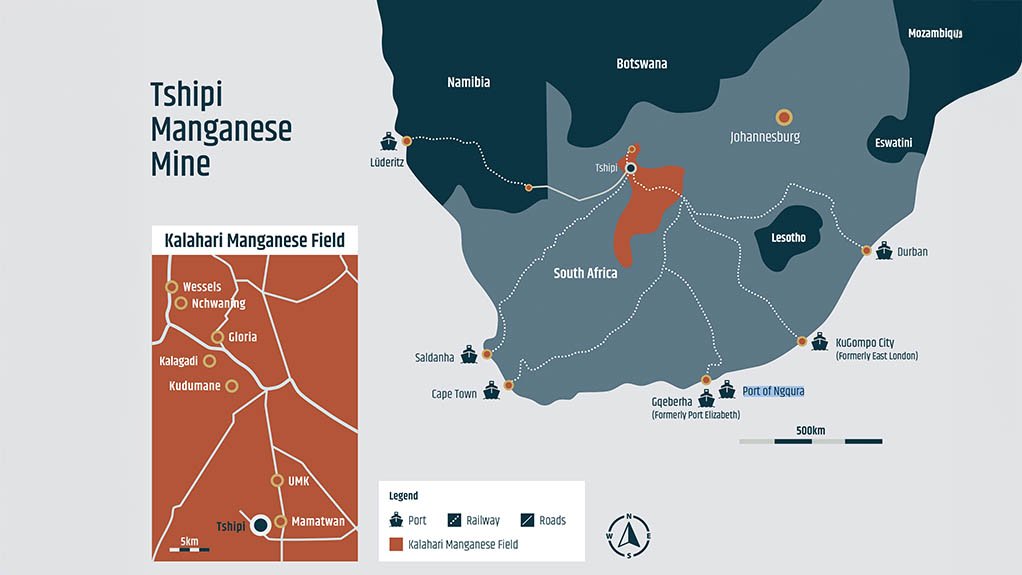


JOHANNESBURG (miningweekly.com) – The plan-beating sale of manganese ore by Jupiter Mines in its financial year 2026 (FY26) included 828 000 t going through the Port of Lüderitz in Namibia, the ASX-listed company stated in its annual report on Wednesday, September 30.
Jupiter owns 49.9% of Tshipi é Ntle Manganese, which operates the Tshipi manganese mine in South Africa’s large, low-cost Kalahari manganese field. South Africa’s JSE-listed Exxaro Resources owns 50.1% of Tshipi, which sold 3.5-million tonnes during this reporting period, exceeding full-year targets and its historical average of 3.4-million tonnes a year.
Use was made of multiple export ports and the ability to shift volumes between rail and road in response to logistics conditions and market demand.
This flexibility strengthened logistics resilience and helped maintain consistent sales despite some variability across the broader South African rail network.
Overall, rail availability during the year exceeded planning assumptions, supported by Tshipi’s continued engagement with State-owned rail enterprise Transnet.
Total rail volumes were 2.6-million tonnes amid Tshipi working with Transnet on KuGompo City (East London) rail capacity and tariff settings, while maintaining discussions with transport providers to secure commercially feasible arrangements and access additional rail capacity as it became available.
Road haulage costs increased during the period as Tshipi used additional road capacity to support offshore exports and respond to rail disruptions, including derailments and planned Transnet shutdowns.
As with other producers in the Kalahari manganese field, logistics represents the largest component of Tshipi’s cost base, reflecting the 1 000 km distance between the mine and export ports.
Tshipi, which transports ore by both rail and road, seeks to maximise the use of lower-cost rail capacity where available.
Tshipi received higher-than-anticipated rail volumes during FY26, reflecting improvements in rail capacity and reliability. These included fewer derailments and cable theft incidents, the introduction of larger wagons and upgrades to rail infrastructure to accommodate them.
Lower-than-expected rail utilisation by emerging miners also increased available network capacity. Continued engagement with Transnet contributed to these improvements, supporting greater logistics efficiency during the year.
A key strategic development was Tshipi’s participation in the long-term Manganese Export Capacity Allocation (MECA3) public-private logistics framework between Transnet and manganese producers. MRCA3 provides participating producers with greater rail and port allocation certainty over a ten-year period, replacing the previous annual allocation process with a longer-term, demand-led model.
For Tshipi, this supports long-term logistics security and improved coordination across rail, road, and port channels.
The agreement is part of a broader industry initiative to improve logistics certainty for South African manganese exporters. Within this framework, focus remains on optimising available capacity, maintaining logistics flexibility, and supporting cost-competitive export performance over the long term. Tshipi’s flexible multi-port network and lower-cost export channels strengthen resilience and support future growth, Jupiter noted in its annual report to Mining Weekly.
Previous export-efficiency improvements have included scaling lower-cost channels through KuGompo City and Lüderitz. Tshipi, in partnership with Tradeport Namibia, is planning a transshipment project at the Port of Lüderitz that would enable larger vessels to load at anchorage, which would reduce overall freight costs. In FY26, the project progressed with ongoing development and expansion work, however, final investment decisions, completion dates, and commissioning milestones remain publicly undisclosed.
HIGH-PURITY MANGANESE SULPHATE MONOHYDRATE
Exploring a downstream entry into high-purity manganese sulphate monohydrate (HPMSM) for electric vehicles (EVs) forms part of the fourth core pillar Jupiter’s strategic framework.
HPMSM is a refined manganese product used in cathode materials predominantly in manganese-rich battery chemistries.
In 2023, Jupiter recognised EV batteries as providing a new and potentially value-adding market and is continuing to advance the opportunity in a phased manner, without the commitment of significant capital.
Jupiter continued to monitor the EV battery market and evaluate the opportunity to produce HPMSM through flowsheet refinement, product validation, and ongoing customer engagement with the broader battery industry.
Jupiter’s strategy includes evaluating the potential to enter the battery-grade manganese market by converting low-grade ore from the Tshipi manganese mine into HPMSM. Tshipi provides access to a long-life manganese resource and low-grade stockpiles that may be suitable as feedstock for HPMSM production
In advancing this opportunity, Jupiter will focus on the derisking of volume and pricing assumptions.
World steel forecasts suggest global 2026 steel demand growth of 0.3%, followed by 2.2% steel demand growth next year.
Tshipi, which translates to “beautiful steel” in Tswana, has a mineral resource that supports more than 100 years of mine life. In FY26, Tshipi’s mining volume totalled 11.89-million bank cubic metres.
Developed steel markets are expected to benefit from a gradual improvement in macroeconomic conditions, easing financial costs and policy measures designed to support domestic steel industries, from which manganese draws most demand.
During the previous reporting period, implementing solar power and battery storage at Tshipi was shown to be a cost-effective, lower-carbon energy solution. Execution timing of this, Jupiter stated, would take into account advances in solar technology, grid reliability, and increasing competition among independent power producers, which may further reduce the cost of procured power.
In the last eight years, Tshipi has enabled Jupiter to deliver dividends of $451-million, which equals more than 90% of Jupiter’s current market capitalisation.
Jupiter reported a net after-tax FY26 profit of $37.6-million.
Article Enquiry
Email Article
Save Article
Feedback
To advertise email advertising@creamermedia.co.za or click here
Projects
Latest Multimedia

Latest News


Showroom
Established in 1933, EKATO is the world leader in agitation technology, supplying agitators for processes and applications such as chemicals and...
VISIT SHOWROOM
Stewarts & Lloyds is a leading steel, tube, and engineering product supplier in South Africa.
VISIT SHOWROOM
Announcements
What's On
Subscribe to improve your user experience...
Option 1 (equivalent of R125 a month):
Receive a weekly copy of Creamer Media's Engineering News & Mining Weekly magazine
(print copy for those in South Africa and e-magazine for those outside of South Africa)
Receive daily email newsletters
Access to full search results
Access archive of magazine back copies
Access to Projects in Progress
Access to ONE Research Report of your choice in PDF format
Option 2 (equivalent of R375 a month):
All benefits from Option 1
PLUS
Access to Creamer Media's Research Channel Africa for ALL Research Reports, in PDF format, on various industrial and mining sectors
including Electricity; Water; Energy Transition; Hydrogen; Roads, Rail and Ports; Coal; Gold; Platinum; Battery Metals; etc.
Already a subscriber?
Forgotten your password?
Receive weekly copy of Creamer Media's Engineering News & Mining Weekly magazine (print copy for those in South Africa and e-magazine for those outside of South Africa)
➕
Recieve daily email newsletters
➕
Access to full search results
➕
Access archive of magazine back copies
➕
Access to Projects in Progress
➕
Access to ONE Research Report of your choice in PDF format
RESEARCH CHANNEL AFRICA
R4500 (equivalent of R375 a month)
SUBSCRIBEAll benefits from Option 1
➕
Access to Creamer Media's Research Channel Africa for ALL Research Reports on various industrial and mining sectors, in PDF format, including on:
Electricity
➕
Water
➕
Energy Transition
➕
Hydrogen
➕
Roads, Rail and Ports
➕
Coal
➕
Gold
➕
Platinum
➕
Battery Metals
➕
etc.
Receive all benefits from Option 1 or Option 2 delivered to numerous people at your company
➕
Multiple User names and Passwords for simultaneous log-ins
➕
Intranet integration access to all in your organisation