Ten years at the wheel, Toyota boss gears up for yet more change

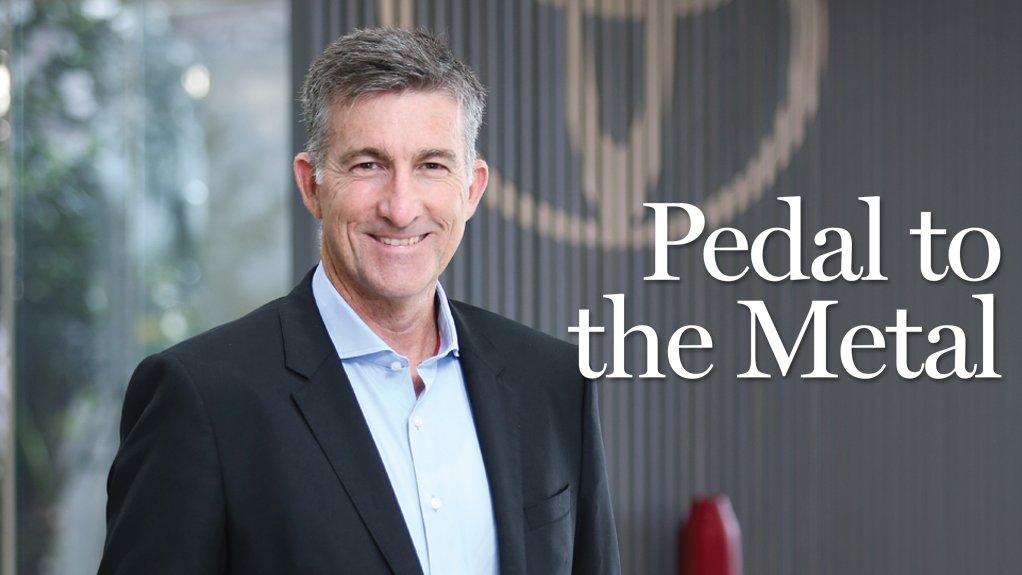


Toyota South Africa Motors (TSAM) president and CEO Andrew Kirby this year marks a decade in the driver’s seat at the country’s best-selling vehicle brand. (Toyota has, in fact, been South Africans’ favourite car brand for 46 years running.)
When Kirby took charge of the Japanese subsidiary in 2016, the automotive industry was a very different place, both globally and on the domestic front.
The market was dominated by well-known Western and Japanese brands, internal- combustion engines ruled the roost, and global trade was a far more predictable beast.
Now, however, Chinese car brands are roaring ahead, including in South Africa; sales of new-energy vehicles (NEVs – hybrids, plug-in hybrids and battery electric vehicles) are growing rapidly; and trade wars have become the norm, rather than the exception.
Gqeberha-born Kirby, whose father worked for Ford at the time, interestingly enough, says the next ten years are likely to continue delivering change, warning that the South African auto industry will have to adapt if it wants to remain relevant in the global context.
But he insists that Toyota will still be number one in South Africa in 2036.
Disruptive Decade
"I have been in the automotive industry for almost 35 years, and the current environment is, from an order-of-magnitude point of view, the most disruptive global environment I have ever seen globally and in South Africa,” says Kirby.
The first category of change has been on the technology front, and not only in terms of drivetrains, but also the sheer volume of in-car technology introduced in the form of safety, software, multimedia and connected features.
“These changes have been very dramatic, and it has fundamentally changed customers’ expectations of what a car should look like,” notes Kirby.
“And it’s not only about the multimedia experience. We now have safety systems that proactively engage to prevent accidents.
“This is a significant technology shift, and it makes our world – as manufacturers – quite complex.”
Another development rendering the current period unique in time is the visible shift in regional dominance.
“We now suddenly have very dominant players in production in India and China,” says Kirby.
“Whilst we all knew these brands were growing, I don't think anyone anticipated the scale and speed at which they have been moving.”
Coupled with this, says Kirby, is the fact that a number of traditional car makers have seen declines in market share and profitability, a matter made worse by their home markets also facing economic difficulties.
“We have seen a lot of international original-equipment manufacturers (OEMs, or vehicle manufacturers) announce massive profit declines,” says Kirby.
“Some are, in fact, making a loss, and we are seeing the closure of plants and significant job losses, not only at OEMs, but also at component manufacturers.
“Of course, this situation is being exacerbated by the current geopolitical environment and unending wave of trade disruptions.”
Kirby highlights that these challenges are only the latest in a series of events that have plagued the global and local auto sectors over the last decade.
The South African automotive sector does not exist in isolation, with the domestic industry reflecting the same realities seen elsewhere in the world over the past ten years.
The six local OEMs are all part of traditional, established brands: Toyota, BMW, Mercedes-Benz, Volkswagen, Isuzu and Ford.
South Africa this year, however, bagged its first Chinese OEM in the form of Chery, which is set to start vehicle assembly in 2027.
Chery took over the Nissan plant in Rosslyn, Tshwane, after the Japanese manufacturer abandoned production in South Africa following decades of local assembly.
“In South Africa, particularly, we find ourselves in an environment where global resources are scarce and the hurdles to get local investments approved by our parent companies have become a lot higher,” says Kirby.
“Of course, we also find ourselves having to deal with that same uncertainty we see in the global market.”
The Road to 2036
Kirby is positive that TSAM will still be producing and selling vehicles in South Africa ten years from now.
“Our intention is to continue improving our competitiveness, and to adapt to the market conditions in South Africa, as well as in our African and European export markets.
“We know there will be some rebalancing in terms of exports, but we intend to still be a major player in 2036.
“Our goal is to still be number one in South Africa, but we’ll have to see if we can retain our 24% market share.”
The current forecast within Toyota SA is that its exports to Europe – currently mainly the Hilux bakkie – will decline over time.
“Over the next five years, the numbers are likely to drop by as much as 50%,” says Kirby.
“This is largely due to drivetrain regulation changes and Euro 7 emission standards coming into effect.
“We know that there are discussions in Europe to soften the timeline, because of the global shifts in the auto sector, but we imagine that this will only serve to slow that 50% drop, not avoid it altogether.”
Kirby expects that Toyota SA will, however, manage to counter its losses in Europe with gains in African markets.
These gains have little to do with the African Continental Free Trade Area Agreement, and more to do with significant infrastructure investments on the continent, healthy economic growth, and an expanding middle class, all of which could potentially boost the pool of new-car buyers significantly.
“Toyota is a dominant player in the African market, and we intend to keep it that way,” says Kirby. “It’s going to be tough, but we are up for the challenge.”
“We know we can’t compete with China on price, especially as most of their manufacturers are heavily subsidised by the Chinese government,” he adds.
“The benefits we gain as local assemblers from government’s Automotive Production and Development Programme (APDP) are not even a fifth of what some research indicates Chinese car makers receive in terms of subsidies.
“This means that we have to focus on what we are good at if we want to be competitive – our customer service, our technical support, our parts support, as well as the vast geographical spread and strength of our dealer network.
“We do, however, acknowledge that there is always room for improvement and that we intend to change where required. We’ll bring in more advanced technology, for example, and make sure our dealers are ready to handle this new level of technology.
“It may not sound too strategic, but it's important to us,” notes Kirby. “And I think our customers have always appreciated that we are there when things go wrong. We respond in a way that drives brand loyalty.”
He adds that it is “easy to sell a bright new thing. It is, however, far more difficult to manage that vehicle over its lifecycle”.
When looking at the bigger, national picture, Kirby says talks have begun between the local automotive industry and government on the APDP and other policy changes that will allow the automotive industry, as South Africa’s biggest manufacturing sector, to keep the factory doors open.
“We are looking at improving the competitiveness of completely knockdown manufacturing compared with imported vehicles, in order to improve the sales mix between locally made and imported vehicles.
“The second goal is to accelerate our transition to NEVs from both a production and sales point of view.
“The third objective is to protect our exports into Europe and the US, and to grow our exports into Africa,” notes Kirby.
“The fourth objective is to increase our local content, as this is a very important jobs driver.
“The fifth and last objective is to secure and improve the opportunities for job creation across the value chains, especially at tier-two and tier-three component suppliers.
“We are hoping for an announcement from the Department of Trade, Industry and Competition on these policy adjustments later this month [October].”
Rationalisation Likely
Prompted to forecast what the 2036 automotive market may look like, Kirby ventures to say that there will be a significant rationalisation of the number of competing brands in the global automotive market.
“Many plants and brands are going to close down, while some brands will strengthen.
“There will also be some rebalancing on who is going to be the dominant car-producing countries by 2036. I think the market in 2036 will look very different than it does today.”
Kirby believes that the majority of Chinese vehicle brands currently active in South Africa will have withdrawn ten years from now.
“You will end up with a number of strong remaining Chinese brands here, but there will be a significant rationalisation before then, with the majority – two-thirds – potentially disappearing.”
There are currently 21 Chinese brands in South Africa, with the tally of brands and sub-brands within China varying on who is doing the counting, but coming in at well over a 100.
“I don't think Chinese vehicle sales have reached their peak yet – not in South Africa or the broader global market,” adds Kirby.
“But we’ll certainly see – and we have started to see it this year already – that there will be a slowing of that growth. It will flatten over time and that is when we can expect to see a rationalisation of these brands.”
Kirby adds that the 2036 power-train mix should feature a “very high percentage” of NEVs.
“I foresee, however, that internal combustion engine vehicles will still be sold, also in the rest of Africa.”
Another big shift will be in terms of safety.
“The number of vehicle accidents in 2036 is going to decline dramatically because of the technological advances we are seeing,” says Kirby.
“This will be boosted by the increasing affordability of these technologies, which will allow even entry-level vehicles to carry an increasing number of safety features.
We’ll see a lot of safer, software-dominant vehicles on the road.”
Kirby believes that the infrastructure in South Africa and the rest of Africa will not allow for fully autonomous driving by 2036, except perhaps on some stretches of well-maintained freeways.
Lessons from the Hot Seat
After ten years in the hot seat, what has the Toyota SA boss learnt about himself?
“Surprisingly, how much I have enjoyed the complexity of the disruptive environment we find ourselves in.”
Kirby says he has also learnt to value his high-performing leadership team, and their culture of respect, teamwork and harmony, even when holding opposing opinions.
“I have just enjoyed being at work and working with the people around me. I have also really enjoyed working with my colleagues outside of Toyota.
“The auto sector in South Africa is unique compared with other places in the world as we collaborate on a lot of industry issues. We have deep respect for each other.”
Kirby says the local industry has proved to be remarkably resilient, especially given the current environment and the fact that vehicle production volumes have been flat “for a very long time”.
He says one of the most significant events of his Toyota tenure was dealing with the flood disaster at the Durban plant in April, 2022, when water levels at the facility reached between 0.7 m and 1.7 m.
“The devastation was unimaginable,” says Kirby, “but we had tremendous support from within the Toyota group. The biggest challenge of my career was navigating our way through that disaster, and my biggest achievement was to restart production.”
The flood at the Prospecton plant prompted one of the largest insurance claims in Africa, at north of R7-billion. The claim was settled in 2023.
Kirby also counts the formulation of the South African Automotive Masterplan during his tenure as naamsa | The Automotive Business Council president as a major personal plus, as well as securing approval from Toyota head office to invest in Corolla Cross and Corolla Cross hybrid production in South Africa – especially as production preparation took place during the Covid-19 pandemic.
“While this was not our highest- volume model, it was a huge achievement for us.”
The latest notable achievement for the Toyota boss is this year’s start of production of the ninth-generation Hilux – still South Africa’s best-selling vehicle – following a record R10.4-billion investment in the Durban plant.
TSAM has three production lines at its Durban facility. The first is for the Hilux/Fortuner, the second is the passenger car line with the Corolla Cross, and the third is the minibus taxi line.
“We are the only South African OEM that produces more than one model range, and our intention is to retain all three production lines, and to keep on investigating what we can add to these three lines,” says Kirby.
Does that mean we will see a new addition to the made- in-South Africa Toyota line-up?
“We are not going to tell the competition what we have up our sleeves,” says Kirby. “Besides, we have just made a major announcement around the Hilux.”
He confirms, however, that Toyota does have significant unused production capacity in Durban – give or take 90 000 units a year.
Looking at this year, however, Kirby says he will be pleased with a 7.5% increase in production over 2025, given the fact that the previous Hilux was on run-out and production of the new model is still ramping up.
Domestic sales are also still growing, with Toyota looking at 4% to 6% growth this year.
Article Enquiry
Email Article
Save Article
Feedback
To advertise email advertising@creamermedia.co.za or click here
Projects


Latest News
Showroom

FLANDERS Southern Africa provides integrated solutions for mining and industrial operations, covering field services, automation, electrification,...
VISIT SHOWROOM
CSIR International Convention Centre (CSIR ICC) - the leading conference and events venue in Pretoria/Tshwane.
VISIT SHOWROOM
Press Office
Announcements
What's On
Subscribe to improve your user experience...
Option 1 (equivalent of R125 a month):
Receive a weekly copy of Creamer Media's Engineering News & Mining Weekly magazine
(print copy for those in South Africa and e-magazine for those outside of South Africa)
Receive daily email newsletters
Access to full search results
Access archive of magazine back copies
Access to Projects in Progress
Access to ONE Research Report of your choice in PDF format
Option 2 (equivalent of R375 a month):
All benefits from Option 1
PLUS
Access to Creamer Media's Research Channel Africa for ALL Research Reports, in PDF format, on various industrial and mining sectors
including Electricity; Water; Energy Transition; Hydrogen; Roads, Rail and Ports; Coal; Gold; Platinum; Battery Metals; etc.
Already a subscriber?
Forgotten your password?
Receive weekly copy of Creamer Media's Engineering News & Mining Weekly magazine (print copy for those in South Africa and e-magazine for those outside of South Africa)
➕
Recieve daily email newsletters
➕
Access to full search results
➕
Access archive of magazine back copies
➕
Access to Projects in Progress
➕
Access to ONE Research Report of your choice in PDF format
RESEARCH CHANNEL AFRICA
R4500 (equivalent of R375 a month)
SUBSCRIBEAll benefits from Option 1
➕
Access to Creamer Media's Research Channel Africa for ALL Research Reports on various industrial and mining sectors, in PDF format, including on:
Electricity
➕
Water
➕
Energy Transition
➕
Hydrogen
➕
Roads, Rail and Ports
➕
Coal
➕
Gold
➕
Platinum
➕
Battery Metals
➕
etc.
Receive all benefits from Option 1 or Option 2 delivered to numerous people at your company
➕
Multiple User names and Passwords for simultaneous log-ins
➕
Intranet integration access to all in your organisation