World Bank proposes small, low-cost AI for developing countries


By adapting small, low-cost AI tools to local conditions, developing countries can bring better medical care, education, judicial services and agricultural extension within reach of millions of people.
International development organisation the World Bank Group's 'World Development Report 2026: The Promise of Artificial Intelligence' states that 16.2% of jobs in developing economies could see productivity meaningfully boosted by AI.
“AI can accelerate growth in developing economies. They do not need large models or big data centres to reap its benefits, but governments must act swiftly to close the gaps in power, connectivity, skills and institutional quality that threaten to leave them behind,” says World Bank Group senior VP and chief economist Indermit Gill.
The report, which is the first comprehensive assessment of AI’s implications for developing countries, shows that AI is helping people, businesses and governments in developing countries solve problems, analyse information, improve forecasts and deliver services at a larger scale.
These capabilities are especially valuable in countries where trained professionals, reliable records and public capacity are often limited.
AI tools can make it easier for doctors to diagnose patients, farmers to improve crop decisions and businesses to become more productive. Governments could also use AI to improve tax collection, social programmes, disaster response, healthcare and education, the report says.
However, AI is spreading faster and is more context-specific than earlier general-purpose technologies like electricity and the Internet.
Developing economies are in the midst of their weakest average growth performance in three decades. AI could significantly boost that performance before the end of the 2020s while delivering tangible benefits to people, the report states.
The opportunity is not guaranteed, however. The most advanced AI systems are being built by a small number of countries and companies, while many developing economies still lack the power, Internet access, data, skills and institutions needed to use AI effectively, the report shows.
Without deliberate action, AI could widen gaps between countries, increase inequality within them, concentrate market power, weaken trust in public institutions and create new risks for safety, rights and social cohesion, the World Bank warns in the report.
To address these risks, the report proposes that developing countries adopt available tools, adapt them to local conditions and, over time, advance toward frontier AI development.
This approach helps countries avoid costly and inefficient attempts to replicate advanced AI before the foundational conditions are in place.
“The window to get this right is narrow. Developing countries that build the foundations now, which are power, connectivity, skills and institutions, will be positioned to adopt and adapt AI for their people. AI presents a once-in-a-lifetime opportunity to solve problems that have resisted solutions for generations,” says World Development Report 2026 director Gaurav Nayyar.
Achieving this requires first investing in the basics. In sub-Saharan Africa, nearly one-third of rural schools lack reliable electricity and more than two-thirds lack dependable Internet access.
Closing this gap is a priority and the World Bank Group is working with partners through Mission 300 to provide energy access to 300-million people across sub-Saharan Africa by 2030, which will lay the foundation for broader digital and AI inclusion.
Countries also need to expand access to computing power and improve the availability of local data, including in local languages, so AI tools can be tailored to serve their own people and economies, the report recommends.
Further, governments should make it easier for new firms to attract investment, test ideas and scale what works.
Many AI pilots are already under way, but the bigger challenge is knowing which ones deliver results. Better evidence, stronger skills and clearer procurement and evaluation frameworks will be essential, the World Bank report says.
Additionally, building public trust is important. As AI evolves rapidly, governments should begin by drawing on voluntary industry standards to encourage responsible use, anchored in international cooperation to prevent regulatory fragmentation.
When voluntary measures fall short, governments should apply existing laws to address harms directly.
Improved public services and better learning outcomes in schools will reinforce trust but, if AI embeds bias in government decisions or erodes data privacy, that trust will be difficult to recover, the report says.
Article Enquiry
Email Article
Save Article
Feedback
To advertise email advertising@creamermedia.co.za or click here
Projects


Latest Multimedia

Latest News


Showroom


Industrial Nozzles & Systems (Pty) Ltd (Est. 2000) exclusive representative in Southern Africa for LECHLER GmbH (Est. 1879) - Europe's leading...
VISIT SHOWROOM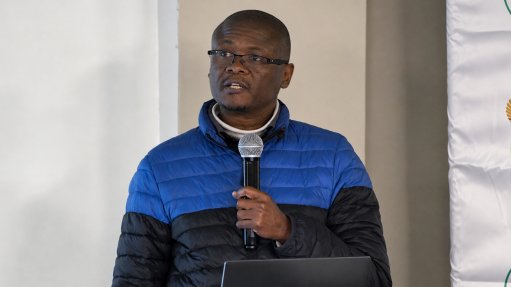



Announcements
What's On
Subscribe to improve your user experience...
Option 1 (equivalent of R125 a month):
Receive a weekly copy of Creamer Media's Engineering News & Mining Weekly magazine
(print copy for those in South Africa and e-magazine for those outside of South Africa)
Receive daily email newsletters
Access to full search results
Access archive of magazine back copies
Access to Projects in Progress
Access to ONE Research Report of your choice in PDF format
Option 2 (equivalent of R375 a month):
All benefits from Option 1
PLUS
Access to Creamer Media's Research Channel Africa for ALL Research Reports, in PDF format, on various industrial and mining sectors
including Electricity; Water; Energy Transition; Hydrogen; Roads, Rail and Ports; Coal; Gold; Platinum; Battery Metals; etc.
Already a subscriber?
Forgotten your password?
Receive weekly copy of Creamer Media's Engineering News & Mining Weekly magazine (print copy for those in South Africa and e-magazine for those outside of South Africa)
➕
Recieve daily email newsletters
➕
Access to full search results
➕
Access archive of magazine back copies
➕
Access to Projects in Progress
➕
Access to ONE Research Report of your choice in PDF format
RESEARCH CHANNEL AFRICA
R4500 (equivalent of R375 a month)
SUBSCRIBEAll benefits from Option 1
➕
Access to Creamer Media's Research Channel Africa for ALL Research Reports on various industrial and mining sectors, in PDF format, including on:
Electricity
➕
Water
➕
Energy Transition
➕
Hydrogen
➕
Roads, Rail and Ports
➕
Coal
➕
Gold
➕
Platinum
➕
Battery Metals
➕
etc.
Receive all benefits from Option 1 or Option 2 delivered to numerous people at your company
➕
Multiple User names and Passwords for simultaneous log-ins
➕
Intranet integration access to all in your organisation