ASP Isotopes says revenues increasing, three business units at inflection point for profitability

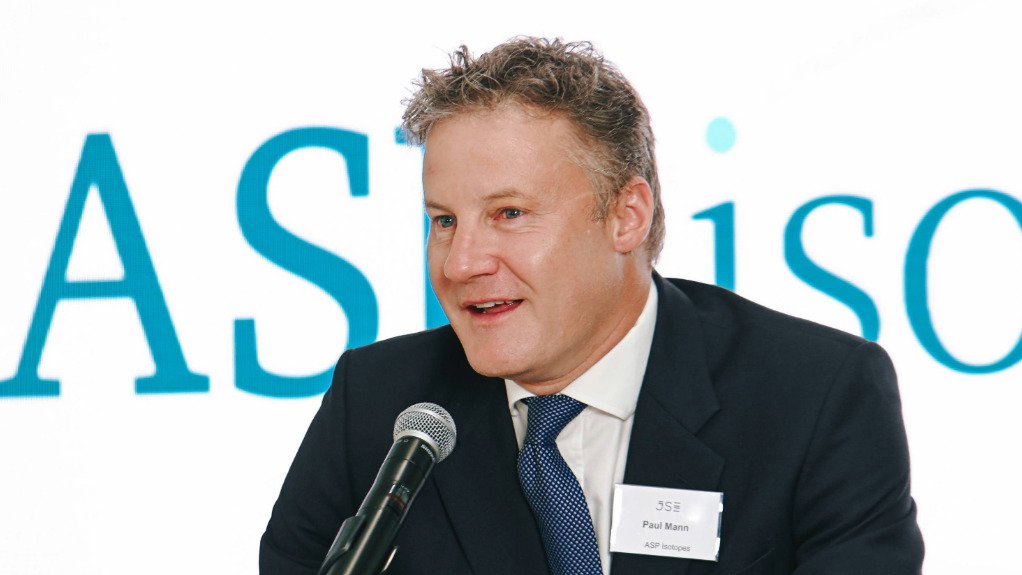


Nasdaq- and JSE-listed advanced materials company ASP Isotopes (ASPI) says all its business units are making considerable progress, group revenues are increasing and three of its business units are at an inflection point and expected to make substantial contributions to achieving profitability in the near term.
In an update to shareholders before the publication of the company's second-quarter financial results, ASPI CEO and executive chairperson Paul Mann says the two divisions responsible for the majority of near to mid-term earnings before interest, taxes, depreciation and amortisation (Ebitda) targets, namely radiopharmaceutical production company PET Labs and liquefied helium (LHe) and liquefied natural gas (LNG) producer Renergen, are operating ahead of internal expectations in terms of timing and potential profitability.
This reinforces ASPI's confidence in its 2031 Ebitda target of greater than $300-million, with the range for Ebitda by 2031 expected to be between $330-million and $700-million.
“We are currently negotiating helium and hydrocarbon supply contracts with potential large global customers on 5- to 15-year take-or-pay arrangements, which gives us considerable visibility over our expected future revenues,” he says.
“Our medium-term strategy is to create a group that holds majority stakes in listed subsidiaries with complementary technologies. Our strong conviction driving this strategy is that listed subsidiaries with their own boards will result in an overall improvement in governance and autonomy.”
ASPI's senior leadership has set strong but achievable goals and the company believes it is on track to deliver on this.
Based on discussions with potential global helium customers, Renergen's anticipated production of helium and LNG alone could potentially achieve the majority of medium-term targets following the expected completion of Phase 2. This projected Ebitda would be primarily secured on long-term 5- to 15-year take-or-pay contracts.
"Further, PET Labs is demonstrating tremendous organic growth and we are in the early innings of a new product cycle in nuclear medicine. Forecasting the growth in stable isotopes is more challenging as product cycles in semiconductors are of longer duration. However, feedback from customers is that there is significant demand for new materials that can improve the efficiency of computing.
"The flip-side to longer-duration product cycles is that, once the products have been adopted into the production cycle, they may become a standard and necessary feature for a long time to come, which aligns with the company's strategy of delivering long-term shareholder value," says Mann.
DIVISIONAL PERFORMANCE
During the first half of this financial year, ASPI's PET Labs group demonstrated organic revenue growth of more than 50% compared with the first half of 2025.
The company forecasts that PET Labs is on track to deliver full-year revenues of about $14-million, up from $6-million in 2025. Its projected growth is on track to deliver an Ebitda of $50-million to $100-million in 2031.
Further, ASPI expects to start helium production at Renergen prior to September 30. At current expected prices, forecast yearly helium and LNG revenues are expected to be approximately $27-million after the completion of Phase 1.
The company anticipates that Phase 1 will reach a planned production capacity of 2 500 GJ of LNG and 250 kg of LHe a day.
In the current geopolitical environment where about 50% of global helium supply is estimated to be currently offline, the world is seeking an additional supplier of helium in a geopolitically neutral location, and ASPI is prioritising helium production to meet these demands, Mann highlights.
Additionally, during the second half of this financial year, Renergen, through the planned reverse merger between business conglomerate Noble Africa and healthcare technology company ENDRA Life Sciences, is expected to become a Nasdaq-listed company upon the closing of the reverse merger, allowing investors to invest in a commercial helium-focused company.
ASPI will initially own approximately 89% of the combined company, after giving effect to the private placement financing that is expected to close immediately prior to completion of the reverse merger, says Mann.
ASPI's nuclear fuels subsidiary Quantum Leap Energy (QLE) continues to pursue a public listing as a separate company. Having raised substantial amounts of capital between 2023 and this year, QLE is well funded through its current development programme and is expected to continue its momentum towards additional milestones, including commercial production of nuclear fuels.
In February, QLE and the South African Nuclear Energy Corporation (Necsa) executed a pre-implementation services contract agreement as part of the planned collaboration on the research, development and ultimately commercial production of high-assay, low-enriched uranium (HALEU), and marking a critical step forward in addressing global nuclear fuel supply needs for next-generation fission reactors.
Necsa's mandate and expertise is in nuclear research and technology innovation and Necsa is among the world's leaders in nuclear technologies. The services contract builds on the existing agreement between ASPI's South African subsidiary and Necsa, and leverages QLE's enrichment capabilities alongside Necsa's world-class capabilities and strategic positioning in the global nuclear value chain.
In South Africa, since the formal commencement of activities, QLE has secured non-proliferation registration, entered into a comprehensive partnership framework with Necsa, obtained formal site and facility allocation, advanced project safety and governance processes and completed independent technical- and facility-readiness assessments.
QLE also received an authorisation covering source material and nuclear-related equipment and technology for enrichment-related activities, with the initial authorisation for cold commissioning of the uranium enrichment test-bench facility.
Authorisation from the South African governmental authorities represents an important milestone for civilian nuclear enrichment activities in South Africa.
Civilian enrichment authorisations of this nature have not been granted in South Africa for multiple decades, which makes this a significant development in the country's civilian nuclear fuel cycle programme.
Meanwhile, the company's Silicon-28 and Ytterbium-176 enrichment facilities are in the final stages of commercial production, and expected to ship initial product during the second half of this financial year.
While the delays in its stable isotope division have been frustrating, these delays are attributable primarily to performance issues with certain equipment provided by former original equipment manufacturer suppliers, not performance issues with ASPI technology.
ASPI's core enrichment technology continues to perform in line with its theoretical models, giving the company strong confidence that these plants will deliver commercial product for industries with urgent need, including next-generation semiconductors and healthcare.
Article Enquiry
Email Article
Save Article
Feedback
To advertise email advertising@creamermedia.co.za or click here
Projects

Latest Multimedia

Latest News
Showroom
Sika South Africa is a trusted partner for the nation’s infrastructure, commercial, residential, and industrial sectors.
VISIT SHOWROOM
The Aluminium Federation of South Africa (AFSA), is the voice of the South African aluminium industry.
VISIT SHOWROOM

Press Office
Announcements
What's On
Subscribe to improve your user experience...
Option 1 (equivalent of R125 a month):
Receive a weekly copy of Creamer Media's Engineering News & Mining Weekly magazine
(print copy for those in South Africa and e-magazine for those outside of South Africa)
Receive daily email newsletters
Access to full search results
Access archive of magazine back copies
Access to Projects in Progress
Access to ONE Research Report of your choice in PDF format
Option 2 (equivalent of R375 a month):
All benefits from Option 1
PLUS
Access to Creamer Media's Research Channel Africa for ALL Research Reports, in PDF format, on various industrial and mining sectors
including Electricity; Water; Energy Transition; Hydrogen; Roads, Rail and Ports; Coal; Gold; Platinum; Battery Metals; etc.
Already a subscriber?
Forgotten your password?
Receive weekly copy of Creamer Media's Engineering News & Mining Weekly magazine (print copy for those in South Africa and e-magazine for those outside of South Africa)
➕
Recieve daily email newsletters
➕
Access to full search results
➕
Access archive of magazine back copies
➕
Access to Projects in Progress
➕
Access to ONE Research Report of your choice in PDF format
RESEARCH CHANNEL AFRICA
R4500 (equivalent of R375 a month)
SUBSCRIBEAll benefits from Option 1
➕
Access to Creamer Media's Research Channel Africa for ALL Research Reports on various industrial and mining sectors, in PDF format, including on:
Electricity
➕
Water
➕
Energy Transition
➕
Hydrogen
➕
Roads, Rail and Ports
➕
Coal
➕
Gold
➕
Platinum
➕
Battery Metals
➕
etc.
Receive all benefits from Option 1 or Option 2 delivered to numerous people at your company
➕
Multiple User names and Passwords for simultaneous log-ins
➕
Intranet integration access to all in your organisation