Global steel demand to remain flat this year on China slowdown

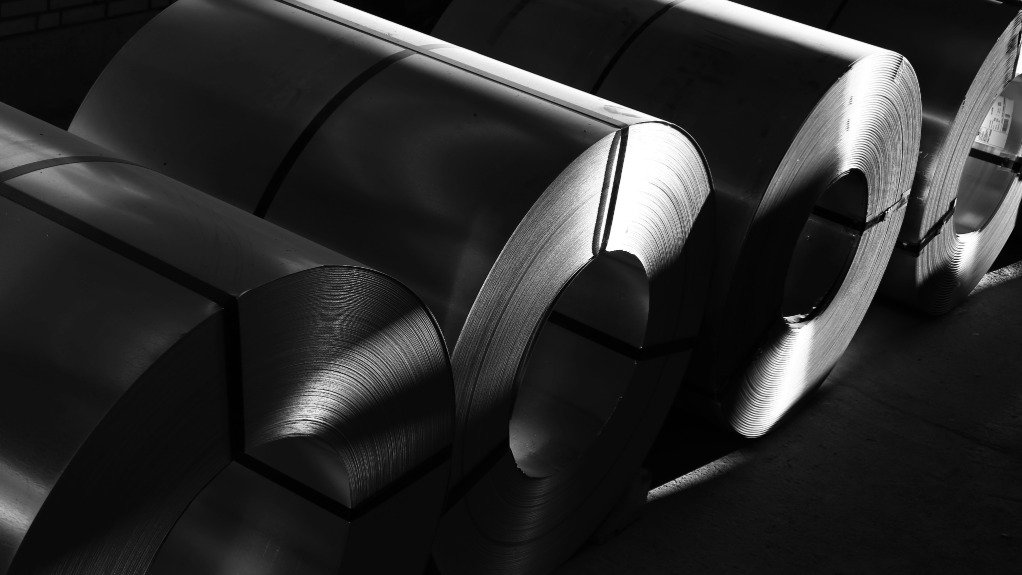



The World Steel Association (worldsteel) forecasts in its latest ‘Short Range Outlook’ that global steel demand will remain essentially unchanged this year at 1.72-billion tonnes, before returning to growth of 1.7% in 2027 to reach 1.75-billion tonnes.
“The trajectory we set out in April holds, but the anticipated recovery is proving slower and more gradual than we had expected. Global steel demand is now forecast to be flat in 2026 rather than to grow modestly, and to grow by 1.7% in 2027 rather than 2.2%,” worldsteel economics committee chairperson Alfonso Hidalgo De Calcerrada says.
“Almost the whole of that revision is a China story. Outside China, demand grows by 1.5% this year and accelerates to 4% in 2027 – precisely the rate we projected six months ago, and one rarely seen in recent times.
“The recovery we described in April is, therefore, not weaker; its momentum is being masked by the scale of China’s structural contraction and compounded by energy-market disruptions stemming from ongoing instability in the Middle East,” he explains.
Calcerrada highlights that one of the most important messages coming from the association’s October forecasts is a reaffirmation of the expectations for a meaningful turnaround in developed world industrial activity and steel demand in 2027.
“Following a stabilisation over 2025 and 2026, developed world industrial activity is expected to show a broad-based recovery in 2027, which is underpinned by growth in AI-related investments, defence and energy transition spending, improving incomes and a supportive policy framework.
“With the developed world growing alongside developing economies excluding China, the outlook for steel demand growth outside China reaches 4% in 2027. Growth on that scale, and that broadly based, has been rare in recent years and is an encouraging signal for the steel industry and the wider economy,” he avers.
This outlook reflects data available as of early September.
In April, worldsteel assumed the conflict in the Middle East would be resolved by June, and it warned that a longer conflict would force material downward revisions.
“The conflict has not been resolved, yet the initial hit to global activity has been less severe than we had assumed. Energy markets absorbed the disruption better than feared and the major economies proved more resilient than our downside case implied.
“Yet, that resilience should not be mistaken for immunity. Where exposure is direct – most acutely across the Gulf – the economic damage is undeniable. While the global economy has absorbed the initial impact, its capacity to buffer subsequent disruptions appears increasingly depleted. For this reason, we maintain a measure of caution regarding the 2027 outlook,” Calcerrada points out.
Worldsteel now expects Chinese steel demand to contract by 2% this year, a downward revision from its April forecast.
The property investment downturn has not decelerated as the association had anticipated.
Infrastructure investment, which it had expected to provide support this year, has instead remained in negative territory.
Steel demand from manufacturing has continued to grow on the back of strong exports, but not by enough to offset the weaker-than-expected performance of real estate and infrastructure.
For 2027, worldsteel expects the contraction in China to narrow to 1%. The real estate downturn is expected to start decelerating while remaining negative, the government retains a cautious stance towards expanding infrastructure investment, and manufacturing should sustain moderate growth provided exports hold up. Trade frictions are, however, emerging as a significant risk, the association points out.
Steel demand in developing economies excluding China is forecast to grow by 1.9% this year and by 5.1% in 2027.
The moderation this year, from the roughly 5% yearly growth recorded in recent years, is driven by the Middle East, where regional conflict has reversed what had been one of the strongest growth stories in the global market.
Elsewhere in the developing world, the underlying momentum is intact, and the 2027 rebound is driven by Developing Asia together with a recovery in the Middle East.
India remains the world’s fastest-growing major steel market, with demand forecast to expand by 7.9% this year to 172.4-million tonnes and by 8% to 186.2-million tonnes in 2027.
Growth continues to be broad-based, with infrastructure-led construction remaining the primary driver.
The Gulf shows the clearest single demonstration of what the conflict has cost, the association points out.
Gulf Cooperation Council (GCC) steel demand grew by 17.7% in 2025, propelled by economic diversification programmes, a healthy project pipeline and strength in housing activity in Saudi Arabia and the United Arab Emirates.
Worldsteel now expects GCC demand to fall by about 11% this year, a sharp reversal of the trajectory it published in April.
“What we observe is not the destruction of demand but its deferral, as project awards, construction starts and financing decisions are pushed back while the security situation remains unresolved.
“On that reading, steel demand in the Gulf should recover strongly once the uncertainty clears, the Strait of Hormuz reopens and the supply chains normalise. Reflecting this optimistic scenario, we forecast a rebound of 11.3% in 2027, taking regional demand back to its 2025 level,” it notes.
Meanwhile, steel demand in Africa is expected to increase by 4.2% to 49.3-million tonnes this year and by 4.8% to 51.6-million tonnes in 2027.
Article Enquiry
Email Article
Save Article
Feedback
To advertise email advertising@creamermedia.co.za or click here

Projects

Latest Multimedia

Latest News

Showroom
Established on 1 March, 2000, by Barries Barnard, Advanced Fire Suppression Technologies (AFST) and the Advanced Group stands as Sub-Saharan...
VISIT SHOWROOM
Astore Keymak is one of South Africa’s leading suppliers of high-quality Thermoplastic Pipeline Systems, with branches in the major provinces.
VISIT SHOWROOM

Press Office
Announcements
What's On
Subscribe to improve your user experience...
Option 1 (equivalent of R125 a month):
Receive a weekly copy of Creamer Media's Engineering News & Mining Weekly magazine
(print copy for those in South Africa and e-magazine for those outside of South Africa)
Receive daily email newsletters
Access to full search results
Access archive of magazine back copies
Access to Projects in Progress
Access to ONE Research Report of your choice in PDF format
Option 2 (equivalent of R375 a month):
All benefits from Option 1
PLUS
Access to Creamer Media's Research Channel Africa for ALL Research Reports, in PDF format, on various industrial and mining sectors
including Electricity; Water; Energy Transition; Hydrogen; Roads, Rail and Ports; Coal; Gold; Platinum; Battery Metals; etc.
Already a subscriber?
Forgotten your password?
Receive weekly copy of Creamer Media's Engineering News & Mining Weekly magazine (print copy for those in South Africa and e-magazine for those outside of South Africa)
➕
Recieve daily email newsletters
➕
Access to full search results
➕
Access archive of magazine back copies
➕
Access to Projects in Progress
➕
Access to ONE Research Report of your choice in PDF format
RESEARCH CHANNEL AFRICA
R4500 (equivalent of R375 a month)
SUBSCRIBEAll benefits from Option 1
➕
Access to Creamer Media's Research Channel Africa for ALL Research Reports on various industrial and mining sectors, in PDF format, including on:
Electricity
➕
Water
➕
Energy Transition
➕
Hydrogen
➕
Roads, Rail and Ports
➕
Coal
➕
Gold
➕
Platinum
➕
Battery Metals
➕
etc.
Receive all benefits from Option 1 or Option 2 delivered to numerous people at your company
➕
Multiple User names and Passwords for simultaneous log-ins
➕
Intranet integration access to all in your organisation